

About the author: Peter Wildeford is a top forecaster, ranked top 1% every year since 2022. Here, he shares the news and analysis that informs his forecasts.
At 2am local time in Caracas on January 3rd, explosions lit up the night sky over Venezuela’s capital. By 5:21am, President Donald Trump announced on Truth Social that Nicolás Maduro and his wife Cilia Flores had been “captured and flown out of the Country.” The operation, codenamed Absolute Resolve, deployed approximately 150 aircraft and sent Maduro to New York to face narco-terrorism charges. And in what could be symbolism or coincidence, the operation occurred exactly 36 years to the day after the US’s capture of Panama’s Manuel Noriega and exactly 6 years after Trump’s strike on Iran’s Qasem Soleimani.
But execution is not the same as strategy. While the operation itself appears to have been flawlessly executed, what comes next isn’t clear. Let’s dig in.
How Venezuela reached the breaking point
Like most events, this is just the continuation of decades of history. We start with Hugo Chávez, a charismatic former paratrooper who won Venezuela’s presidency in 1998 on a wave of populist anger. Flush with oil revenue during the commodity boom of the 2000s, Chávez built a socialist state that redistributed wealth to the poor while systematically dismantling democratic institutions. When Chávez died of cancer in March 2013, he left behind a handpicked successor: Nicolás Maduro.
But the petrostate model that was successful for Chávez had begun unraveling. Global oil prices collapsed from over $100 per barrel in 2014 to below $30 by early 2016. Venezuela’s economy, dependent on oil for 95% of export revenue, imploded. Hospitals ran out of medicine. Grocery stores emptied.
Maduro responded not with reform but with repression. When the opposition won control of the National Assembly in 2015, he packed the Supreme Court and created a parallel legislature to strip it of power. When protesters filled the streets in 2017, security forces killed over 160. Opposition leaders were jailed, exiled, or banned from office.
The 2018 presidential election — which Maduro “won” after banning his main rivals — triggered an international crisis. In January 2019, Juan Guaidó, a 35-year-old opposition legislator, declared himself interim president under a constitutional provision allowing the Assembly head to assume power when the presidency is deemed illegitimately won. The Trump administration recognized him within minutes. Nearly 60 countries followed.
But Guaidó never gained control of anything that mattered. The military stayed loyal to Maduro. By December 2022, his public support had collapsed to single digits, and the Maduro opposition parties supporting Guaidó voted to pull the plug and dissolve his interim parallel government, realizing they had accomplished nothing. Guaidó now lives in exile in Miami.
María Corina Machado, recent Nobel Peace Prize winner, represented something different. When the opposition held primaries in October 2023, Machado won with 93% of the vote. Polls showed her crushing Maduro in a general election. So the regime did what it always does: the Supreme Court upheld a 15-year ban on her holding office, citing her support for US sanctions and involvement with Guaidó. But rather than concede, Machado found a workaround: Edmundo González, a 75-year-old retired diplomat with no desire to campaign, who agreed to serve as her stand-in.
On July 28, 2024, Venezuelans went to the polls. The government’s response was brazenly fraudulent. The National Electoral Council declared Maduro the winner with 51.95% without publishing the precinct-by-precinct tallies that had accompanied every previous Venezuelan election. Officials blamed a “cyberattack from North Macedonia” — completely baseless.
But the opposition had prepared. In incredible bravery and coordination, approximately one million volunteers secretly collected the election tally sheets from over 83.5% of polling stations on election night. Their data told a starkly different story: González had won with roughly 67% to Maduro’s 30%.
But Maduro was undeterred and what followed was brutal repression. Security forces went door-to-door arresting protesters, poll workers, and opposition members. González fled to Spain in September after authorities issued an arrest warrant and Machado went underground.
When Maduro proceeded with his inauguration on January 10, 2025, the Trump administration began escalating pressure. The bounty on Maduro was raised to $50 million, the highest in State Department history. By late 2025, the US had deployed the USS Gerald R. Ford carrier strike group, approximately 15,000 soldiers, F-35 jets, and a nuclear-powered submarine to the Caribbean. Trump declared a “blockade” and announced the country was “completely surrounded by the largest Armada ever assembled in the History of South America.”
Then came today.
Absolute Resolve
The operation had been months in the making. CIA teams tracked Maduro’s pattern of life — where he slept, what he ate, how he moved. US forces rehearsed the raid on a replica of his residence. Trinidad and Tobago quietly signed an agreement granting US military access to its airports. By late December, troops were staged and waiting for favorable conditions.
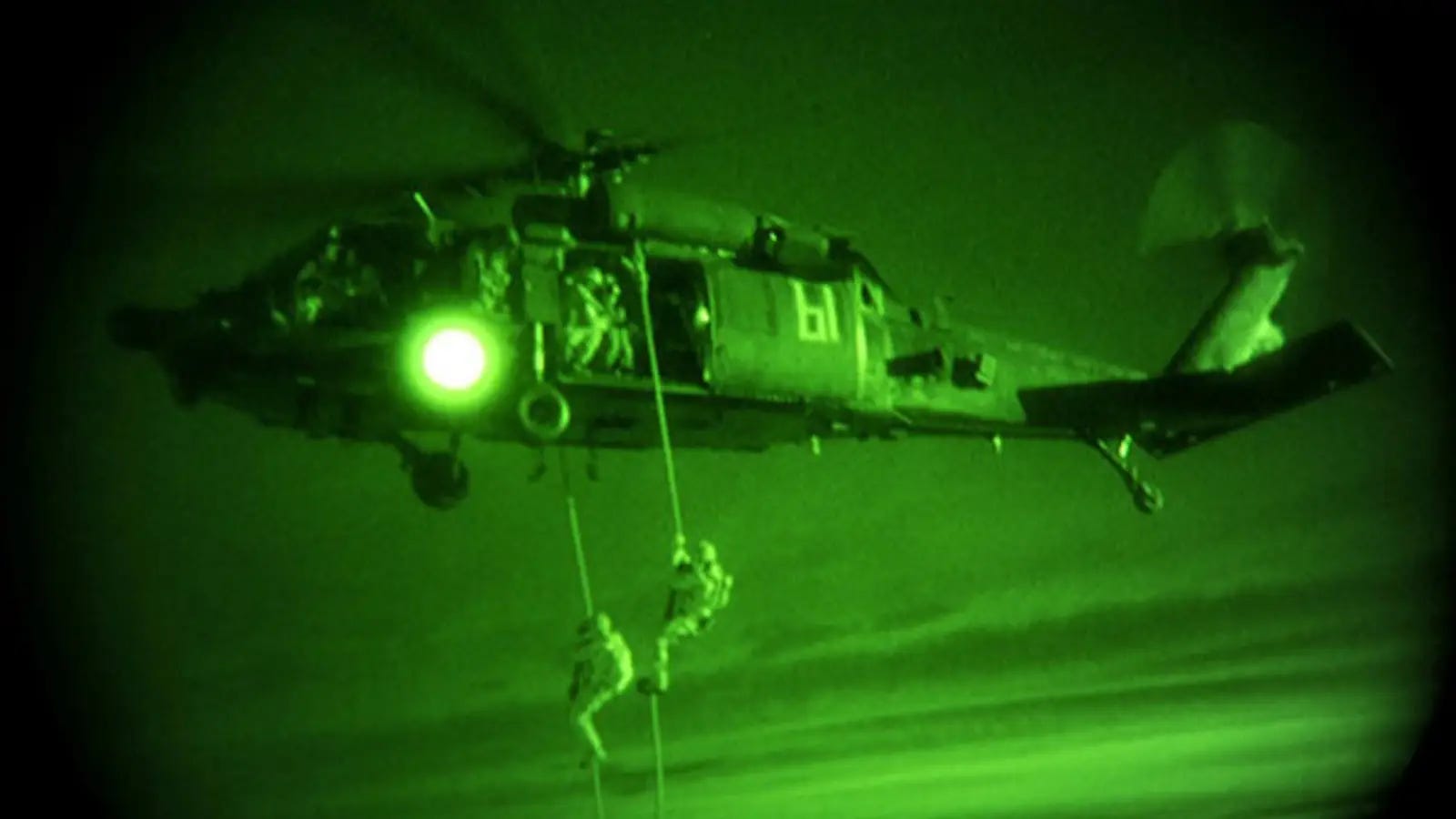
Trump gave final approval around 11 PM Eastern on January 2. The weather was good. The trigger was pulled. 50 aircraft launched from 20 different bases to dismantle Venezuela’s air defenses and clear a path for the helicopters coming behind them. Parts of southern Caracas went dark in what Trump later said was due to “certain expertise.” Behind the air assault came the 160th Special Operations Aviation Regiment that carried Delta Force operators with a specific target: Maduro’s residence inside Fort Tiuna.
According to Trump, Maduro was in “a house that was more like a fortress than a house. It had steel doors, it had what they call a safety space — solid steel all around. He didn’t get that space closed. He was trying to get into it, but he got bum rushed so fast that he didn’t get into that.” No Americans died. By 3:29 AM Eastern, the assault force was back over water, Maduro in hand.
Opposition sources told Sky News they believe Maduro’s capture was a “negotiated exit,” with portions of the regime facilitating rather than resisting. The evidence is circumstantial but suggestive: despite months of warning, Venezuela’s Russian-supplied S-300 air defense systems never prevented helicopter ingress. The military mounted no meaningful counterattack. Interior Minister Diosdado Cabello appeared on television vowing defiance, but the streets remained largely empty.
Whether this was collapse, capitulation, or negotiated exit, the result is the same: for the first time since the US toppled Panama’s dictator Noriega in 1990, the United States has forcibly removed a sitting head of state from power.
The strategic logic
But why Venezuela and why now? The Trump administration is explicitly not calling this regime change but instead framing the operation as the Department of Justice executing an arrest warrant. “At its core, this was an arrest of two indicted fugitives of American justice, and the Department of War supported the Department of Justice in that job,” Rubio said at the Mar-a-Lago presser.
But this seems flimsy — it definitely does seem to be regime change. And maybe this is justified. Maduro is genuinely a bad guy. He stole an election, became dictator, was repressive, is leading a lot of cocaine trafficking, and drove 20% of the population to flee the country. The humanitarian and democratic case against him is airtight.
Additionally, while Trump owns the operation, Venezuela has been Rubio’s white whale for years. He had consistently been the most hawkish voice on Caracas in the Senate, viewing Maduro’s removal as both a strategic imperative and good politics with Florida’s Cuban and Venezuelan voters. This continued as Rubio joined the Trump administration. In July, Rubio posted that “Maduro is NOT the President of Venezuela” but rather “the head of the Cartel de Los Soles, a narco-terror organization which has taken possession of a country.” At the presser, he was already pivoting to Cuba, noting that Maduro’s security detail and spy agency were “basically full of Cubans” and warning Havana that “I’d be concerned.”
Moreover, the oil angle is explicit. Trump announced the US would be “very strongly involved” in Venezuela’s oil industry, with American companies moving in to extract wealth that would flow to both Venezuela and “the United States in the form of reimbursement.” Venezuela has the world’s largest proven oil reserves. Whether this is opportunism layered onto the drug war justification or the actual primary motivation, Trump isn’t hiding that it’s part of the motivation.
What does this mean for geopolitics?
But there’s also a geopolitical strategic case for toppling Maduro. Venezuela has hosted Russian military assets—Tu-160 bombers visited in 2018 and 2024, and Russian advisors have been embedded with Venezuelan forces. China holds billions in Venezuelan debt and has been receiving sanctioned oil shipments.
Back in 1902, Venezuela of all places was facing a blockade not from US forces but from European forces. Venezuela had defaulted on its debts to European creditors and so Britain, Germany, and Italy responded by blockading Venezuelan ports. US President Theodore Roosevelt watched with alarm, seeing that the Europeans might use this as a basis to return to the colonialization of the Americas. Roosevelt declared the Roosevelt Corollary — the US should be the police of the Americas, not Europe. This was an expansion to the earlier 1823 Monroe Doctrine, a declaration from President James Monroe that the Americas were in the sphere of influence of the US and no longer open for colonization from Europe.
As Anthony Constantini argued, the Trump administration has been developing what amounts to a “Trump Corollary” to go along with the "Roosevelt Corollary”, updating the Monroe Doctrine for the 21st century. The Trump Corollary extends American dominance claims over the entire Americas beyond military presence to economic influence, hence the pressure over Chinese-controlled ports at the Panama Canal. Having a hostile drug-smuggling dictator with Russian and Chinese military ties 1,300 miles from Miami is exactly the kind of problem the Monroe Doctrine was designed to address, let alone the Trump Corollary.
This reassertion of hemispheric dominance invites a question: does it signal a broader return to great power spheres of influence? The French term pré carré — literally “square field” — describes the logic of exclusive domains, where Russia claims its near abroad, China asserts control over East Asia (including Taiwan), and the US enforces primacy in the Western Hemisphere but retreats from Europe and Asia. Under this framework, major powers implicitly agree to stay out of each other’s backyards.
There’s perhaps something to this interpretation. Trump has shown little appetite for defending Ukraine, and his pressure on European allies to handle their own defense suggests a willingness to let that theater go. Venezuela would then represent America claiming its pré carré while ceding others to rival powers.
The December 2025 National Security Strategy provides our best window into the administration’s thinking, which actually put the Western Hemisphere appears first among regional priorities — before Asia, before Europe, before the Middle East. The strategy explicitly calls for “a readjustment of our global military presence to address urgent threats in our Hemisphere... and away from theaters whose relative import to American national security has declined in recent decades.”
Here the language on the “Trump Corollary” is unambiguous: “We will deny non-Hemispheric competitors the ability to position forces or other threatening capabilities, or to own or control strategically vital assets, in our Hemisphere.” This is the Roosevelt Corollary with updated targets — swap European colonial powers for Chinese port operators and Russian military advisors.
An alternative perspective is what analyst Tanner Greer calls the “prioritizer” framework, under which China is a unique peer competitor and threat to the US, requiring America’s full attention and focus. Under this logic, the US saves its power for countering China, avoids lasting entanglements in Europe and the Middle East, but does use decisive force for discrete, limited objectives.
It’s not clear what, if any, logic Trump is following. Perhaps Trump’s approach is neither cleanly pré carré or “prioritizer” but something more opportunistic. The strategy asserts hemispheric dominance aggressively while adopting a more transactional posture toward great power competition. The statement that “the days of the United States propping up the entire world order like Atlas are over” is telling. This isn’t sphere-of-influence realism so much as selective assertiveness, with maximum force where costs are low and benefits are tangible, across targets as wide ranging as Venezuela, Iran, and even Nigeria — but explicit restraint or burden-shifting where they’re not, like Ukraine. Where Taiwan falls on this logic is not immediately clear — strategic ambiguity at its finest.
What happens next?
But of course, the harder question is what comes for Venezuela after the helicopters leave. While the execution was successful, there doesn’t seem to be any clear plan for what comes next.
The Noriega parallels are striking — both leaders faced drug trafficking indictments, both stole elections, and the US recognized the opposition candidate as legitimate. But the differences matter more. In Panama, the US already had 12,000+ troops stationed in the Canal Zone — roughly the size of the entire Panamanian military — and a government-in-waiting ready to assume power. Venezuela is 12 times larger with over 100,000 troops equipped with Russian weapons. There is no equivalent infrastructure for transition.
Additionally, Noriega was the beginning and end of the Noriega dictatorship. But the Maduro dictatorship is more embedded — Maduro was never just about Maduro. There instead remains is a collective dictatorship — security services, patronage networks, illicit finance pipelines, and a political-military elite that shares criminal liability with Maduro and faces their own US indictments. Interior Minister Diosdado Cabello, who appeared on television today saying the Venezuelan government would not be cowed, carries a $25 million bounty of his own. Defense Minister Vladimir Padrino Lopez has run Venezuela’s military longer than anyone in modern history and remains in place.
The snake has been decapitated, but the body is still moving. The existing post-Maduro Venezuelan regime might abide by what Trump wants, but they remain staffed by people who face their own indictments and have every incentive to resist a democratic transition that would hand them to American courts.
Venezuelan reaction has been deeply polarized. In Doral, Florida — home to the largest Venezuelan diaspora community in the US — crowds gathered outside El Arepazo restaurant chanting “Libertad!” and singing both national anthems. Similar celebrations erupted in Santiago, Lima, and Madrid, where one Venezuelan told CNN: “At first we were crying because our country was being bombed, but when we were told they had Maduro, the reaction was overwhelming.”
Inside Venezuela, the picture is grimmer. Caracas residents described waking up terrified. “How do I feel? Scared, like everyone,” one resident told the news. “Venezuelans woke up scared, many families couldn’t sleep.” Pro-Maduro supporters led by Caracas Mayor Carmen Meléndez marched through the capital demanding his return, chanting “Maduro, hold on, the people are rising up!” The streets were otherwise largely empty, patrolled by security forces, as residents stayed indoors absorbing what had happened.
When it comes to figuring out who should govern Venezuela next, opposition leader Machado issued a statement calling for González to assume the presidency. But Trump said it would be “very tough” and that Machado “doesn’t have the support or the respect within the country.” His team had not been in touch with her or any member of the Maduro opposition.
And there’s also a constitutional wrinkle. Executive Vice President Delcy Rodríguez is technically Maduro’s legal successor — and she’s reportedly in Moscow. The US wants to work with Rodríguez over Machado and González, despite Rodríguez being a committed Chavista who appeared on state TV demanding Maduro’s release as “the only president of Venezuela.” And this dismissal of Machado is striking and underexplained. Recall that Machado won the opposition primary decisively.
Why? Perhaps Trump cares more about stability and oil access than democratic transition. Rodríguez represents continuity with the existing power structure whereas Machado represents upheaval. Or perhaps portions of the Maduro regime negotiated this outcome and accepting Rodríguez was the price of Venezuelan non-resistance. Or perhaps the Trump administration has no plan and is improvising on the fly. Perhaps Trump wanted the win, got the win, and figured they’d sort out the details later. Note that none of these three theories are mutually exclusive.
Trump’s stated plan is for the United States to “run” Venezuela “until such time as we can do a safe, proper and judicious transition,” with American oil companies moving in to extract wealth that would flow to both Venezuela and “the United States in the form of reimbursement.” But that’s barely a plan. Run it how? With what personnel? Under what legal authority? “Running” a country of 28 million people without boots on the ground isn’t a plan. Capturing Maduro doesn’t automatically produce Venezuelan democracy.
And Democrats are furious. The Gang of Eight, a bipartisan group of Congressional leaders, are normally briefed in advance due to requirements by law to maintain balance between executive war powers and congressional oversight. But they weren’t briefed this time. Trump’s justification—that “Congress has a tendency to leak”—is essentially a middle finger to Article I, which normally puts Congress in the drivers seat when it comes to war. Article II does give the US President authority to do military operations to protect US personnel from an actual or imminent attack, but the imminent attack framing is doing a lot of work here for an operation targeting a leader who posed no immediate threat to American forces.
Looking forward
Across Venezuela, Fordow, and Soleimani, a pattern emerges — the willingness to use overwhelming military power for specific objectives, combined with an unwillingness to own the consequences indefinitely.
But the most important part is that there was no 100,000+ troop occupation, no nation-building doctrine, no decade-long-plus commitment. There was just a precise operation with a specific target, executed and completed within hours. After American foreign policy has been haunted by Iraq for two decades, Trump shows a model of limited military action that accomplishes discrete foreign policy objectives without the quagmire of full-scale invasion.
Sometimes these gambits work. The Abraham Accords, a series of US-brokered agreements signed in 2020 that normalized diplomatic relations between Israel and several Arab nations — including the UAE, Bahrain, Morocco, and Sudan — were dismissed as superficial PR but turned out to be genuinely durable.
Whether that bet pays off in Venezuela will tell us a great deal about how the next three years unfold. If the transition succeeds, expect this template to be applied elsewhere — perhaps Cuba, perhaps Nicaragua, perhaps targets we haven’t anticipated. If it fails, we’ll learn something important about the limits of precision force in an era of diffuse power.
I’m genuinely uncertain which way this goes. It’s good that Maduro is out, but I’m worried about whether democracy is what comes next.
-
Thanks to Caroline Jeanmaire for help with editing and contributing analysis.
Who is your best bet for the next leader of Venezuela?
Peter, your work is always as good as it gets. Thank you for everything you do!
Hoping for an update from you on METR’s time horizon eval results for Opus 4.5 (4 hrs 49 mins) whenever they publish the full results. If the 7 month doubling time holds, we’d get near week long tasks by September 2028. METR sets their AI R&D automation threat model (which is >10x’ing an AI researcher’s speed) at 40 hrs